
The Wolf and the Seven Little Kids
(for analysis skip to “A story for parents and their children)
We start off with the description of the mother Goat and her love for her 7 children. One day, the mother needs to go into the forest for some food, so she calls her children and tells them about the wolf and how they will know if he is trying to trick them. She says that the wolf will have a rough voice and black paws, and that they will know he is the wolf by these signs.
The kids say that they understand, and the mother leaves, content that her children will be safe. Very soon after the mother leaves, the wolf knocks at the door. The wolf pretends to be the children’s mother and tries to make them open the door.
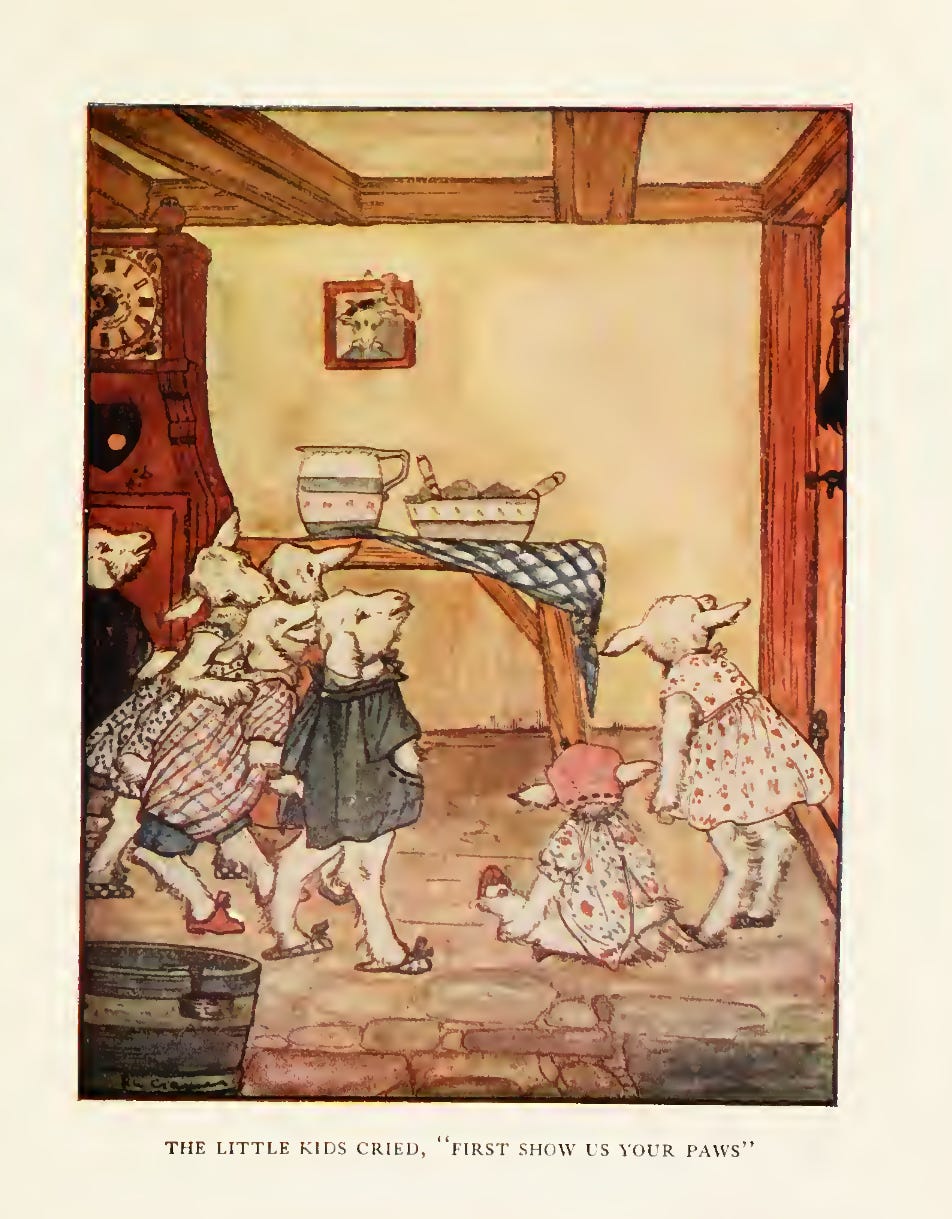
But the wolf has a rough voice, so the children don’t open the door, and they tell the wolf, “You are not our mother. She has a soft, pleasant voice, but your voice is rough.”
So the wolf goes away, buys, and eats some chalk to soften his voice. Again, he tries the same strategy. His soft voice fools the children, but he puts his paws on the window, and his paws are black. By this, the children know he is the wolf, and tell him, “We will not open the door, our mother has not black feet like you.”
So the wolf goes away again. In his desire to eat the children, he goes to the baker and lies to him. “I have hurt my feet, rub some dough over them for me,” he requests. The baker listens, and the wolf goes to the miller. “Strew some white meal over my feet for me,” he commands. But the miller knows that the wolf seeks to deceive someone, and he refuses the request.
After he refuses, the wolf threatens him. “If you will not do it, I will devour you.” So the miller puts the white meal on the wolf’s paws, and the wolf returns to the children.
He tries to gain entry again. His voice fools the children, and the wolf puts his now-white paws on the window for the children to see. So the children let him in.
When they realize they have let the wolf in, all the children run around, seeking to hide. The wolf finds every child except the youngest, who is hiding in the clock case. After this, the wolf went out to the meadow nearby and took a nap under a tree.
Eventually, the mother returns home. Upon finding the door open and the house in ruin, she enters and begins searching for her children. Eventually, at the sound of her tears, the youngest speaks from the clock and lets the mother know she is there.
The mother learns what happened from the youngest, and after some time, goes out into the meadow. When she arrives, she finds the wolf sleeping there, “snoring so loud that the branches shook.” The mother also noticed that the wolf’s stomach was moving. This gave her hope that her children might still be alive.
She tells her youngest to fetch her scissors, needle, and thread from the house. Once the mother has them, she cuts open the wolf’s belly, and out spring all of her other 6 children. The children all rejoice, but the mother has a plan.
She tells her children to gather big stones, and with them she refills the wolf’s stomach. Then she stitches his stomach shut, and the family returns home.
The wolf wakes up and realizes his stomach is filled with stones, which are also making him very thirsty. So he wanders over to the well, but when leaning down to drink, he falls in and drowns.
The kids see the wolf fall in, and they tell their mother the good news. The whole family then dances around the well where the wolf was killed.
A story for parents and their children
This story is both wonderful in its message and beautifully simple. With messages to both parents and children about danger, how it manifests itself, and how to recover after encountering danger.
To start with, we have the message to the parents. A home where parents grow complacent or lazy is a home where terrible things happen.
This story is a warning to parents in general not to grow complacent and leave their children alone, especially when a known evil exists nearby. The evil and most basic forms of human depravity sneak in and influence children in far more subtle and dangerous ways when a responsible and vigilant adult is not present to correct a terrible influence.
Yet in the inevitable chance that a parent makes a mistake and their children encounter or are gobbled up by evil, there is still hope. This hope comes in the knowledge and wisdom of the parent, built up over the period of their lifetime. In this story, this wisdom comes in the form of the mother’s scissors and sewing materials. With quick action, the mother goat not only saves her children from becoming one with the evil but also defeats it entirely.
Equally important is how the woman enacts her revenge. The wolf is sleeping, defenseless, and empty of children. Why does the mother not take a kitchen knife and kill it? Why does she not solve the problem in any other way? To be honest, I’m not entirely sure on this one. However, I believe it has to do with her own wisdom.
Women are not as strong as men, and sheep or goats are definitely weaker than wolves. Both men and wolves have more animalistic reactions to danger. If the woman had attempted to attack the wolf, what is to say the wolf wouldn’t have woken up and fought back?
Another way of looking at this is to ask: what is better when it comes to evil? Is it better to risk harming yourself and undoing your good actions, or is it better to set a trap for the individual who is evil, minimizing risk to yourself? This mother uses her knowledge to set the perfect trap for the wolf. One that both causes him immense discomfort and an equally painful demise.
Turning to the wolf, I have noticed in these old stories a theme of devouring people whole. In this story, the wolf manages to devour six whole small sheep. This is quite the feat, and gives whole new meaning to “inhaling one’s food.” But there is a bit more to it than just silly child imagery. In almost every fairy tale, the wolf symbolizes some form of evil.
In this specific story, the wolf starts out wanting to eat the children. To do so, he buys chalk to soften his voice and deceive the children. As he grows hungrier, however, he resorts to lying, then threatening to eat another person outright in order to get his way.
After he finally receives his ill-gotten reward, he immediately grows complacent. Resting under a nearby tree, having indulged in so much eating that he is unable to be woken up, even when being cut open.
In this way, we see evil in three different ways. First, we have the tenacity towards an evil goal, with the methods used to pursue it slowly growing more evil. Second, we have the laziness and overindulgence that follow when a person finally accomplishes a sought-after goal. Lastly, we have the slowly corrupting nature of evil.
With the first, we have the tenacity of evil to obtain a goal. If a person has an evil goal in mind, such as devouring innocent children, what will they not do to reach that goal? Eating children is allegedly considered very evil. If the core of your drive is something so (allegedly) evil, then there is nothing logically stopping you from doing something less evil to get what you want.
In other words, an evil goal is not simply evil because of the end goal of your actions. An evil goal is evil because it also corrupts what you are willing to do on the path of fulfilling your goal.
These dangers are similar to those of having a single-minded goal and are largely summed up by the phrase “mindless pursuit.” Yet even when finishing the task, one more danger awaits people of single-minded pursuit. Who doesn’t like to relax after a hard day’s work, after all?
This leads us to our second way of seeing evil. Laziness and overindulgence. The wolf likely only really needed to eat one or two little sheep. If he had practiced moderation, he likely would have been able to avoid the mother goat and attempt to steal her other children again later, when he was hungry again.
This gives a great way to spot the signs of an overly hungry nature. Before a greedy individual’s nature is satisfied, one resorts to increasing levels of corruption to get what one wants. As they get what they want, individuals overlook many things, including future consequences and even important details. After this person finishes obtaining what they want, they then grow lazy and complacent.
I will use the average sex-seeking youth for my explanation here. If they are single-minded, the individual will use coercion and maybe even small threats and lies to tempt their target. Once they have seduced their target, they will overlook important aspects of sex, often what their partner wants immediately before, during, or after sex. After they have finished getting what they want, the individual grows lazy. Unwilling to continue the effort of pleasing their partner. I believe this sums up one-night stands quite well, and it leads well into our third point: slow corruption.
In every story involving a wolf, the wolf usually eats all its victims whole. However, after the individuals are cut from the wolf’s stomach, they tend to be just fine. This doesn’t make sense from a biological perspective or even from the perspective of the person who gets eaten, but it does make sense if you view the wolf eating people as a metaphorical evil attempting to corrupt the good.
It takes time for evil to truly corrupt a person who has good moral character. The wolf’s digestive process could just as easily be viewed as someone “becoming one with” the wolf. With this, the individual loses all hope of returning to the good, innocent young sheep they were before.
If you manage to save the individuals before they are fully corrupted, you can not only maintain their purity, but also increase their wisdom.
This is why parents (or saviors) must be vigilant. Readiness to save your children from their inevitable mistakes and the influence of evil is just as important, if not more important, than simply telling them what to look out for.
With that, we can start to look at the children themselves. You might have noticed how naive the children are almost immediately. Why are the children telling the wolf what he needs to do in order to enter the house? Innocently pointing out what it is that the other person is doing wrong is exactly what will land you in the most trouble.
Utilizing the phrase “never stop your enemy in the middle of a mistake,” The wolf capitalizes on the children pointing out his mistakes. Going out, he solves the problems and returns. After only a few attempts, the wolf convinces the children that he is a trustworthy figure. “I’m basically your mother, trust me as you would her” is the wolf’s plan from the beginning, and he succeeds because naivety cannot withstand malicious intent.
It is only after realizing that the wolf has betrayed their trust that the children are in danger. I think this is also very accurate in real life. When someone is attempting to gain your trust, you must be the most cautious. You are not in danger while someone is convincing you they are trustworthy. You are in danger when you think a person is trustworthy and start listening to them despite other warnings. This is how cults operate, as well as how individuals fall prey to manipulative people.
Think of the naive sheep here. There are a dozen different ways they could have assured themselves that the sheep was, in fact, their mother. Simply asking the wolf what their names were would have been a very easy solution. Put another way, the mother’s warnings are good, but do not function if the person who hears them does not use their brain to think of other ways they could be deceived.
After the children have been tricked, they scatter. Naive innocence stands no chance against someone who is truly hellbent on harm and destruction. The only child who escapes is the youngest, who hides in the clock.
This might just be due to size and luck. The smallest is the hardest to find, after all. If I look a little bit deeper, perhaps this youngest escaping is more closely related to the fact that the youngest children are always the least willing to leave their mother’s side. If the wolf is a metaphor for an evil influence, the youngest child is the least likely to be corrupted by it.
Last but certainly not least, we have the conclusion to our tale. After the mother heroically saves the children and intelligently sets a trap for the wolf, the children gather around the well. They begin to dance around it, celebrating the demise of a terrible enemy.
This is a very important message. If you manage to kill or defeat something that is evil, you should celebrate. It is a satisfying conclusion to the story, but I want to add a little more to what you can take from this tale.
The idea of celebrating the death of a wrongdoer makes men physically happy, but makes women feel empathy for the accused. In a study researching male and female reactions to the outcome of a trial, men react with pleasure to a guilty verdict of a guilty man. Men also react with empathy when an innocent man is wrongfully convicted. Women react with empathy in both scenarios. A good point of warning for society in general and empathetic women specifically is that you must celebrate the death of evil.
The point of celebrating the death of evil is not just to allow joy to come from what was a bad situation. It instills in your children that evil is something you kill, preferably painfully. Anything else, and the evil comes back to harm you.
Think about if this story were written in the modern day. This wolf would undoubtedly get a tragic backstory. He was starving, his family abandoned him, in short, he would have received the Disney evil character treatment. This is the wrong way to look at evil. It is also a naive way of looking at evil. A way that allows evil not only to flourish, but also encourages more people to become evil.
When it comes to evil, you celebrate its death, you bring about its death, and you orchestrate its death in as painful a way as you can manage. You trick the wolf into drowning in the well. You send a message to other wolves that you are not an easy target. Anything else, and more children get eaten.
Join me when I next get around to writing and recording. I’ll be covering Rapunzel. Not the Rapunzel you know and love, but the Rapunzel where two parents sell their child for a delicious looking salad.
If you’d like to keep up to date with my episodes, feel free to subscribe.


